

The last decade has witnessed a fast pace of development in technology, and there is no better innovation than Artificial Intelligence Explained. AI has penetrated daily life in the form of smartphones and online shopping, healthcare, and transportation, among others.
In this step-by-step tutorial, we will have a simplistic and realistic look at what the term Artificial Intelligence is all about, how it works in the background, and how it is slowly creeping into our day-to-day lives – whether we realize it or not, the manner in which we begin our working lives, or even the manner in which we interact with others. The article is purely educational and aimed at assisting the beginners in getting to know the artificial intelligence in simple and realistic terms.
The knowledge of AI is not a luxury anymore. With the increasing smartness of digital systems, individuals and businesses need to understand how the systems work to utilize them safely, responsibly and effectively.
Introduction to Artificial Intelligence
Artificial Intelligence (AI) is computer systems meant to achieve functions that are traditionally carried out by human intellect. These activities are learning, reasoning, decision making, language understanding and problem solving.
Put simply, AI enables machines to think and act in a manner that is similar to that of humans.
Artificial Intelligence is a combination of various technologies including:
Data
Algorithms
Computing power
Pattern recognition
Machine learning models
Contrary to a regular software which operates given instructions, AI systems are data-driven and get better with time.
For example:
The voice assistant can perceive spoken language.
Product recommendation system: This is where a system will recommend products according to your interests.
A navigation application determines the most optimal way.
These are real life applications of AI in Daily Life which people interact with on a daily basis, and in most instances do not even notice it.
For further general understanding of Artificial Intelligence concepts, you can also explore resources available at IBM Artificial Intelligence Guide.
Artificial Intelligence Explained: How Does AI Work?
To understand Artificial Intelligence Explained properly, it is important to look at its basic working structure. The majority of AI systems are based on three steps:
Data Collection (Input)
AI systems are used to gather a great deal of data in:
User interactions
Sensors
Cameras
Text input
Online activity
To take an example, when you go online to search something, the expression you type in becomes input data.
Processing and Learning of Data
Having gathered data, AI systems process it with the help of algorithms. Algorithms are groups of directions, which assist the system to detect patterns.
Machine learning is frequently used in AI and it implies:
The system studies patterns
It finds relationships
It enhances performance in the long run
For example:
Social media websites profile your viewing.
Shopping sites control what you purchase.
Spam is automatically identified in email systems.
Output or Decision
The AI system returns the following results after the data processing is complete:
Recommendations
Predictions
Automated responses
Notifications
Most of our uses of AI applications are based on the input-process-output system, which is the simplest structure of AI application.
The 7 Strong AI Applications in Everyday Life
And now we are going to discuss seven key fields of how AI is actively influencing the contemporary society.
Artificial Intelligence in Smartphones and Voice Assistants
What It Is
Assistants that are powered by AI can process voice commands and react.
How It Works
Voice recognition is used to transfer voice to text. The interpretation of meaning is done through natural language processing (NLP). The system then gives out a reply.
Real-Life Uses
Setting reminders
Sending messages
Searching online
Breaking in and breaking out smart home devices
Benefits
Hands-free convenience
Faster task completion
Accessibility for users
Awareness & Safety
Privacy settings should be reviewed, and the users are to be aware how voice data is stored.
Future Trends
It is likely that voice assistants will be more personal and conversational.
AI in Healthcare
Healthcare has been among the most critical and life-altering sectors to which Artificial Intelligence is creating a significant impact.
What It Is
AI assists physicians in processing medical data and enhancing the accuracy of diagnosis.
How It Works
The AI systems examine medical images, patient history, and research databases in order to find patterns.
Real-Life Uses
Disease detection
Medical imaging analysis
Individualized treatment prescriptions
Benefits
Early diagnosis
Improved patient care
Reduced human error
Awareness & Safety
Professionals should not be substituted by medical AI, but it should assist experts in making decisions.
Future Trends
AI will have a greater contribution in predictive healthcare and remote monitoring.
Artificial Intelligence in On-line Shopping and Recommendations
E-commerce platforms are very conspicuous with AI which assists in enhancing user experience and recommendations.
What It Is
AI suggests products according to the preferences and behavior of the user.
How It Works
The system is based on the analysis of the browsing history, past purchases and ratings of products.
Real-Life Uses
Product suggestions
Personalized ads
Inventory management
Benefits
Better shopping experience
Time savings
Better product discovery
Awareness & Safety
Consumers need to learn about the use of their browsing history by platforms.
Future Trends
Greater individualized and live suggestions.
AI in Banking and Finance
AI is relevant to financial institutions to enhance efficiency and security.
What It Is
The AI watches the transactions and identifies abnormal patterns.
How It Works
Machine learning algorithms use current transaction information.
Real-Life Uses
Fraud detection
Credit scoring
Chatbots customer service
Benefits
Enhanced security
Faster services
Reduced fraud risk
Awareness & Safety
Customers are supposed to make security options such as two-factor authentication.
Future Trends
Artificial intelligence financial planning technologies will be more customer-friendly.
Artificial Intelligence in Transport and Navigation
AI has a significant role in contemporary transportation.
What It Is
AI assists in traffic optimization and enhanced route management.
How It Works
Navigation applications do traffic analysis, GPS positioning, and user feedback.
Real-Life Uses
Real-time traffic updates
Ride-sharing matching
Route optimization
Benefits
Time savings
Reduced fuel consumption
Improved road safety
Awareness & Safety
Automation should not be left unequivocally to drivers.
Future Trends
Self-driving cars and intelligent roads.
AI in Education
Artificial Intelligence Explained is incomplete without education.
What It Is
AI is in aid of digital learning systems.
How It Works
Artificial intelligence assesses student progress and modifies the learning materials.
Real-Life Uses
Individualized learning courses
Automated grading
Virtual tutoring
Benefits
Flexible education
Improved engagement
Better progress tracking
Awareness & Safety
Students are expected to check and be academically responsible.
Future Trends
More engaging and interactive AI-based learning systems.
AI in Smart Homes and IoT
The emergence of smart homes is a clear example of the inclusion of AI in our daily lives.
What It Is
AI links domestic appliances and can be used to automate processes.
How It Works
The devices interact via the internet and react to patterns.
Real-Life Uses
Smart lighting
Temperature control
Security monitoring
Benefits
Energy efficiency
Convenience
Enhanced security
Awareness & Safety
Wi-Fi networks and passwords are needed to be secure.
Future Trends
More intelligent automation and less required personnel.
For additional neutral educational resources about AI developments, you may refer to Encyclopaedia Britannica – Artificial Intelligence.
Artificial Intelligence Advantage in Everyday Life
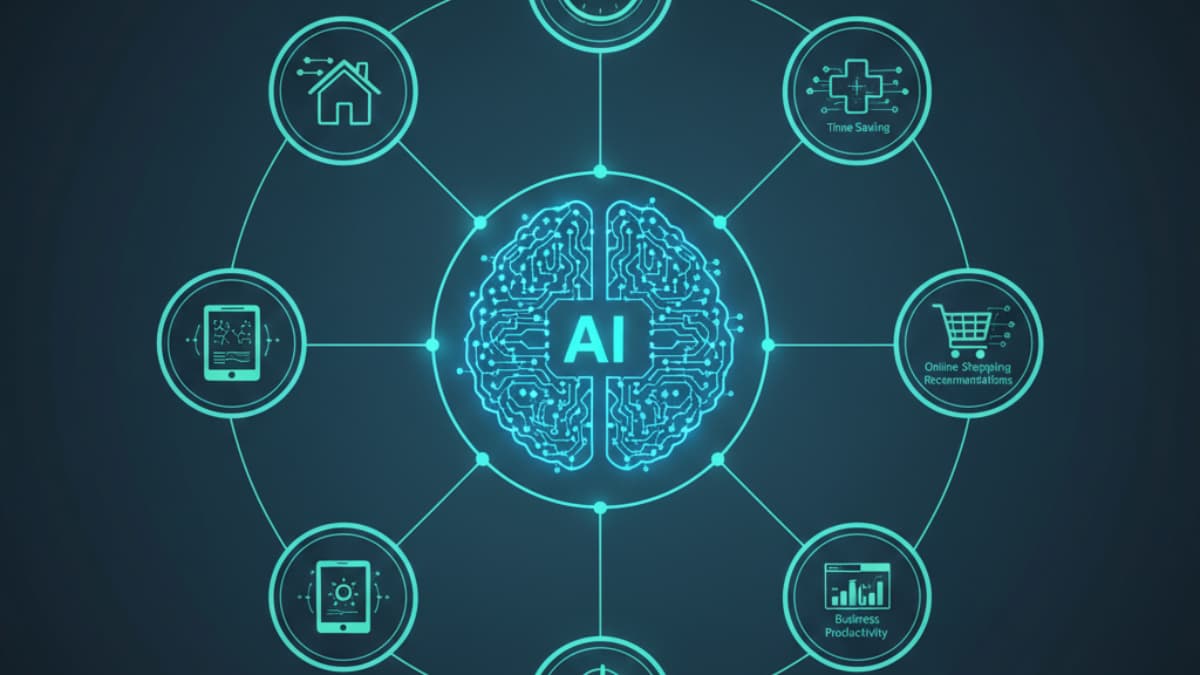 The effects of AI are not only convenient.
Key advantages include:
Increased productivity
Faster decision-making
Repetitive jobs to be automated
Improved accuracy
Enhanced user experiences
Opportunities of business growth
Artificial intelligence is emerging as an effective instrument of both individuals and groups.
Consciousness and Security in the Application of AI
Although AI has numerous advantages, it is necessary to use it responsibly.
Users should:
Protect personal data
Use strong passwords
Enable security features
Conceptualize privacy policies
Do not share sensitive information because of no necessity
The use of Artificial Intelligence must be ethical and responsible to create trust and sustainability in the long term.
Artificial Intelligence: Future Prospects
The future of AI is shifting to the more advanced knowledge of human language:
Smart machine learning applications
More advanced automation
A better and more realistic perception of human language
Ethical AI development
Increased AI system transparency
AI will continue to expand in our daily lives to a larger role in healthcare, business, education, and even transportation.
Nevertheless, it will become more focused on responsible AI governance and data protection.
Conclusion
In this ultimate guide, we have examined the actual definition of Artificial Intelligence, we have come to the know of how it works in a non-technical manner, as well as we have seen how it is gradually transforming contemporary society through its application in our daily lives.
Since smartphones and healthcare, AI has been integrated into the daily routine, whether in the finance sector or in smart homes. It increases productivity, decision-making, and establishes new opportunities in industries.
Being aware of artificial intelligence allows one to operate digital devices in an intelligent, safe, and responsible way.
Artificial Intelligence has nothing to do with depriving humans of something, it is about making humans more functional and creating a smarter digital future.