

Digital Awareness has become a core competence of life in a society that is getting more interconnected. Digital systems have become essential in the daily activities of the UK in aspects of banking, access to healthcare, education, shopping and communication. Although technology is efficient and convenient, it also presents such threats as fraud, misinformation, identity theft, and privacy invasion.
Being digitally savvy in 2026 does not simply imply that one knows how to operate a smartphone or the computer. It involves learning about the online threats, responsible online behaviour, personal information protection, and critical thinking concerning the information that is read online. This is a complete Online Awareness Guide that will be discussed to define the Digital Safety Skills that every person in the UK must master to be safe, knowledgeable and secure in the online world.
This guide will assist all students, all parents, all employees, and all business professionals to improve their Digital Awareness UK standards and meet the current principles of Internet Safety Education.
What Is Digital Awareness in 2026?
Digital Awareness is the capacity to employ the digital technologies in a responsible, safe, ethical, and effective manner. It combines elements of:
Online safety
Data protection
Critical thinking
Responsible communication
Learning the digital rights and responsibilities
Digital Literacy 2026 is not just restricted to technicality in 2026. It entails the knowledge of the impact of algorithm on the nature of content, the functioning of online scams, and the impact of the digital footprint on long-term reputation.
Digital Awareness has nothing to do with fear, it has to do with making informed decisions.
The reasons why Digital Awareness is important in the UK
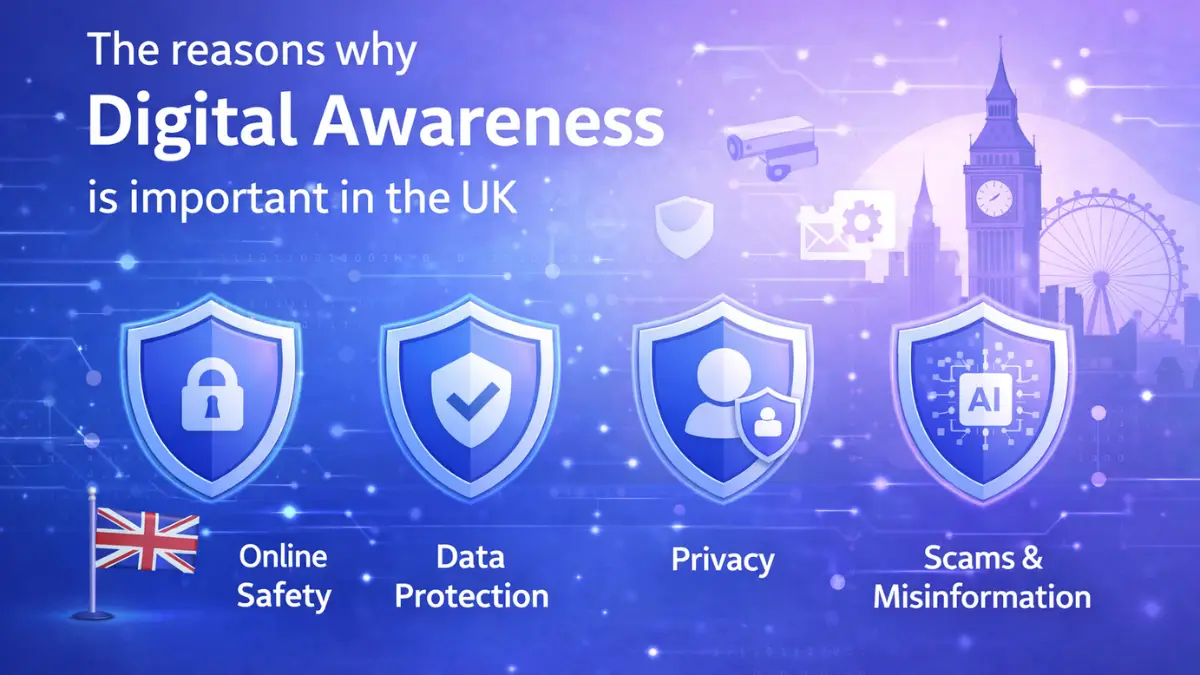 UK possesses a highly digitized public infrastructure in Europe. Citizens routinely use:
Online banking platforms
NHS digital services
Government portals
E-learning systems
Remote work tools
Through this online addiction, there are higher risks. Going through the UK cybersecurity reports, phishing email, impersonation scam and the misinformation campaign are still widespread.
The UK standards of strong Digital Awareness assist people:
Protect financial accounts
Protect the personal identity
Avoid online manipulation
Be professionally credible
Assure safety of children online
Responsible citizenship now includes Digital Awareness.
12 Digital Safety Skills That Will Be Crucially Important in 2026
The 12 most valuable Digital Safety Skills that people need to hone on in the list shown below.
Online Privacy Decryption
Why It Matters
Lots of individuals use social media or applications without checking the privacy settings. All default settings usually permit more sharing of information than users can imagine.
Practical Steps
Check privacy settings of every social site
Keep a limited number of friends
Turn off location sharing when you do not need it
Limit app access (camera, microphone, contacts)
The first step to becoming Digital Aware is to manage exposing personal data.
Managing and Creation of Strong Passwords
The use of weak passwords is among the major causes of account breach.
Best Practices
Use at least 12-16 characters
Use a combination of letters, numbers and symbols
Wilderness No personal details (birthdays, names)
Password-manager Use a reputable password manager
Allow two-factor authentication (2FA)
The practice of strong authentication is an element of Digital Awareness.
To Identify Phishing and Scam Tactics
The counterfeit emails and deceptive messages can be logical.
Warning Signs
Expressive use of language (“Act immediately”)
Suspicious links
Orders of personal or financial information
Unusual sender addresses
Official sites should be used to confirm linking. Internet Safety Education promotes scepticism.
How to Recognize Misinformation and Fake News
By 2026, the social media algorithms can easily propagate misinformation.
How to Verify Information
Validity of the source
Check various reliable sources
Look for publication dates
Watch out against emotionally colored headlines
Digital Awareness cannot be achieved by scrolling.
Securing Personal Data with Wi-Fi in the Open
Sensitive information can be revealed using the public Wi-Fi networks.
Safer Practices
Please do not use public networks to do online banking
Use secure websites (HTTPS)
Think of relying on the services of reliable VPN
Log out of accounts after use
Network risk understanding falls under the contemporary Digital Literacy 2026.
Controlling Your Online Presence
Each online behavior is documented.
Why It Matters
Employers go through online profiles
Higher education institutions examine online behavior
Sharing on social networks can re-emerge several years later
Action Steps
Periodically run a search on your name
Delete outdated accounts
Do not put sensitive information
Consider before expressing views in society
Digital Awareness encompasses reputational management on the long-term basis.
Safe Online Shopping Habits
E-commerce is expanding throughout the UK.
Secure Shopping Tips
Buy from verified retailers
Do not accept unrealistic offers
Use secure payment gateways
Check bank statements on a regular basis
Such practices will avoid financial wastage and will support the Digital Awareness UK standards.
Knowing Data Protection Rights
Data protection laws apply to the residents of the UK.
Key Concepts
Right of access to personal data
Entitlement to make corrections
Right to request deletion
Transparency in data usage
Being aware of your rights in the digital world is a source of confidence and responsible action in the online environment.
For official UK guidance on data rights, refer to the Information Commissioner’s Office (ICO):
Educating Children on Digital Awareness
Children get exposed to online dangers in most cases without knowing.
Guidance for Parents
Set screen time boundaries
Talk on-line behaviour freely
Educate children against sharing of personal information
Promote communicating suspicious messages
Lifelong Resilience in Internet Safety Education is developed very early.
You can also explore online safety advice from the UK Safer Internet Centre:
Digital Responsibility in Workplaces
Digital Awareness is needed in professional settings.
Workplace Best Practices
Do not send confidential information through unsecure email
Be aware of social engineering
Official means of communication should be used
Adhere to company security measures on cybersecurity
The Digital Awareness in the workplace secures both the employees as well as the organisation.
Learning about Artificial Intelligence and Algorithms
The AI systems have an impact on the content that users view.
Why Awareness Matters
Algorithms shape news feeds
Data on behaviour is gathered through targeted advertising
AI generated content can be natural sounding
Knowing the impact of algorithms will assist users to make better decisions.
Engaging in Mindful Digital Managing
Internet communication does not have a tone or a context.
Good Digital Etiquette
Avoid hostile language
Be tactful and not emotional
Respect differing opinions
Avoid spreading rumours
Other aspects of Digital Awareness are ethical behaviour and online civility.
Real-Life Application: Digital Awareness in Day-to-Day Life
Although this is not a real life scenario, suppose one gets a message which states that it is his bank and he is required to verify immediately.
The person who is digitally conscious would:
Avoid clicking the link
Confirm the email of the sender
Go to the bank official website
Call customer care using certified channels
This is a mere lapse that averts loss of money.
Digital Awareness relates to critical thinking in times of stress.
Professional Reflections: Developing Digital Literacy 2026 Standards
In 2026, analysts believe that Digital Literacy 2026 would need to add to it:
Technical competence
Critical thinking
Ethical responsibility
Emotional intelligence
Digital Awareness UK efforts are now more centered around educating schools, training workers and also creating awareness in communities.
Awareness creation is not a single undertaking it is an ongoing learning process.
Top Ten Online Scams
The educated users commit avoidable errors.
Frequent Mistakes
Reusing passwords
Clicking unfamiliar links
Excessive personal information disclosure
Ignoring software updates
Relied upon claims of viral social media
Awareness is created when a person thinks about the behaviour and manipulates habits.
Advantageous effects of a High Digital Awareness
The benefits of spending time in Digital Awareness are in the long-term:
Reduced risk of fraud
Greater online confidence
Better business reputation
More protection of privacy
Better decision-making
More secure experiences of families on the internet
The Digital Awareness makes technology an asset rather than a liability.
Frequently asked questions (FAQ)
So simply put what is Digital Awareness?
Digital Awareness is the knowledge on how to use internet in a safe and responsible and intelligent way without compromising on personal information.
What is the relevance of Digital Awareness in UK?
Due to the popularity of the digital services in bank services, healthcare, education, and government services, awareness lowers the security risks.
Does Digital Awareness Equal Digital literacy 2026?
Digital Literacy 2026 has got technical skills whereas Digital Awareness is more concerned about their safety, ethical and critical thought. Both are interconnected.
What can be done to enhance Digital Awareness in students?
Students are able to check privacy settings, check the sources of information, use a strong password, and do not be too keen on sharing personal information.
Is Digital Awareness something that needs technical skills?
No. It demands informed behaviour and responsible habits not high levels of technical understanding.
Conclusion
Digital Awareness in 2026 is not only about the use of technology, however, but wise use of technology. Whether it is safeguarding personal information and detecting fake news or handling online trails and learn about AI impact, Digital Awareness helps people to navigate the Internet and feel safe and secure doing so.
To anyone in the UK, having good Digital Safety Skills is a guarantee of protection even in the long term, professional respectability, and responsible involvement in the digital society. Through increased Digital Awareness UK standards and by adopting continual Internet Safety Education, we will provide a safer and smarter Internet to all.
Digital Awareness is a life long skill that can be developed through experience, contemplation as well as informed action.