
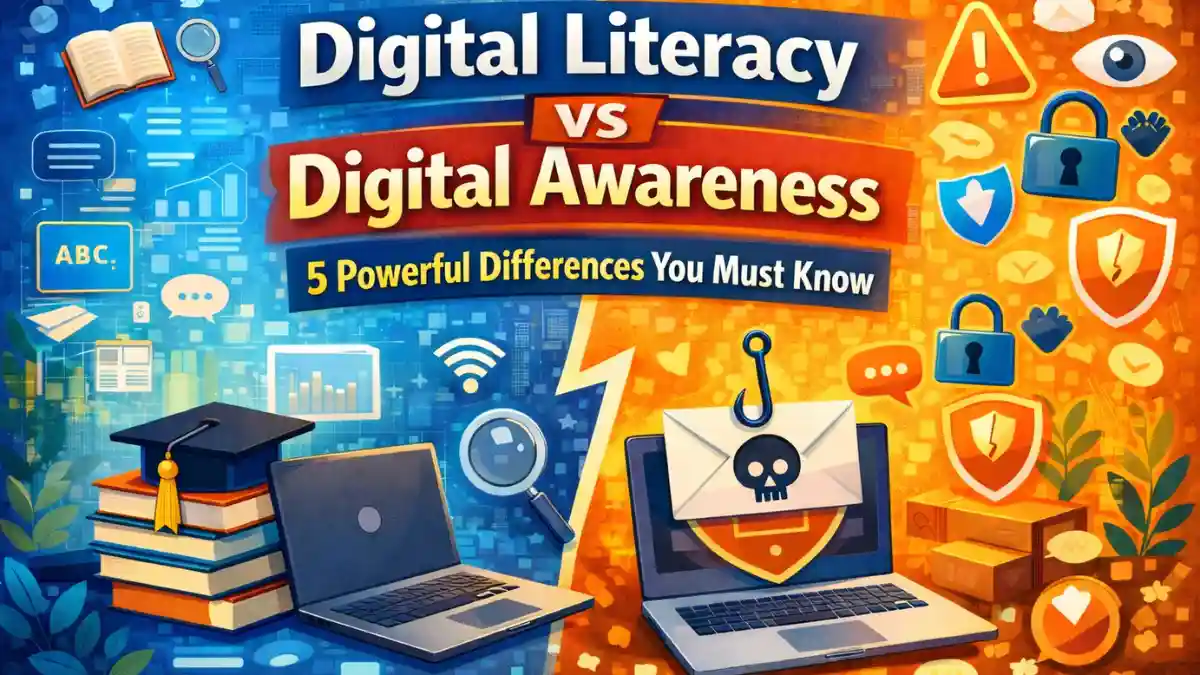
In today’s connected world, understanding the difference between Digital Literacy vs Digital Awareness is more important than ever. Students, professionals, parents, and educators communicate with digital platforms on a daily basis yet do not all of them really know how to use technology efficiently and reasonably. Although these two terms are used interchangeably, they reflect the difference in skills and levels of knowledge.
Digital literacy is concerned with the skill to use the digital tools effectively and critically. Digital awareness, in its turn, focuses on gaining knowledge about the risks, duties and ethical consequences of being online. Both have become indispensable in the contemporary society because the digital environments have added effects on education, employment, communication, and personal decision-making.
This in-depth guide breaks down the concept of digital literacy, emphasizes the value of digital skills education, and shares practical advice to help individuals strengthen their knowledge and awareness. As a teacher or a student or a lifelong learner looking to have an online source of knowledge, this article is clear and has given practical guidelines.
What Is Digital Literacy?
Understanding the Digital Literacy Meaning
Digital literacy can be described as the capacity to find, assess, generate and transmit information through digital technologies. It does not just cover the rudimentary computer skills. It consists rather of critical thinking, responsive content and evaluation of information.
Digital literacy comprises at most fundamental level:
-
Using online equipment (computers, tablets, smartphones)
-
Browsing the internet successfully
-
Information credibility with online information
-
Creating digital content
-
Learning about collaboration tools online
-
Protecting personal data
To put it simply, digital literacy helps to respond to the question:
Are you able to make good use of online resources to realize your objectives?
Digital Communication in Practice
Digital literacy is shown when a university student performs an online research, is able to:
-
Use advanced search filters.
-
Compare multiple sources.
-
Find acceptable scholarly sources.
-
Cite sources properly.
-
Deliver current results with the help of digital tools, such as slides or collaborative services.
This is not just clicking links but it involves critical thinking and organized computer literacy.
What Is Digital Awareness?
Digital awareness is a concept of knowledge on the impact, risks, ethics and responsibilities of using digital technology.
It includes:
-
Consciousness of internet privacy threats.
-
Learning about online trails.
-
Recognizing misinformation
-
Being respectful when on the internet.
-
Identifying cyber threats
-
Understanding digital limits of legal and ethics.
Digital awareness provides the answer to the question:
Are you aware of the implications and liabilities of being on-line?
Digital Digital Awareness in Action
Take an example of a social media professional post. Digital awareness involves:
-
Learning about the possibility of getting a negative impact on reputation as a result of posting.
-
Adjusting privacy settings
-
It is necessary to avoid the sharing of sensitive data.
-
Being aware of the possible misinformation.
-
Observing intellectual property rights.
Responsible behavior in the digital space is created by digital awareness.
Digital Literacy vs Digital Awareness: Core Differences
Understanding Digital Literacy vs Digital Awareness requires examining their core distinctions.
| Aspect | Digital Literacy | Digital Awareness |
|---|---|---|
| Focus | Skills & Competence | Responsibility & Understanding |
| Objective | Use technology effectively | Use technology responsibly |
| Scope | Technical + cognitive skills | Ethical + safety considerations |
| Outcome | Productivity & efficiency | Safety & informed decision-making |
In practical terms:
-
Digital literacy enables you to use tools.
-
Digital awareness ensures you use them wisely.
Both are interconnected but not identical.
Why Digital Literacy vs Digital Awareness Matters in Education
The Role of Digital Skills Education
The contemporary classroom has become dependent on the digital platform. Effective digital skills education should focus on building both digital literacy and digital awareness.
Students need:
-
Research skills
-
Presentation tools mastery
-
The use of collaboration platforms.
-
Cybersecurity awareness
-
Internet etiquette knowledge.
When a student discovers the knowledge on how to download resources but fails to identify the credibility, then the student is digitally literate yet aware.
For structured educational digital frameworks, refer to:
On-the-Job Learning Situation
The text written by a student with an AI writing device:
-
Digital literacy: Being familiar with the tool.
-
Digital knowledge: Knowledge of plagiarism rules and academic integrity.
There should be balanced education that addresses both.
Taking a look at Digital Literacy and Digital Awareness in the Workplace
 Professionals are exposed to complicated online worlds. The inability to distinguish between digital literacy and digital awareness may lead to severe outcomes.
Digital Literacy within the Workplace
-
Managing spreadsheets
-
Project management tools.
-
Conducting data analysis
-
Virtual collaboration
Online Consciousness in the workplace
-
Secrecy of confidential information.
-
Informing about phishing emails.
-
Knowledge on compliance standards.
-
Sharing of misinformation should be avoided.
A very competent employee who is not aware of it will end up sharing company information without knowing it.
How to enhance digital literacy in libraries step-by-step
Digital literacy has to be enhanced through organized work.
Step 1: Master Basic Tools
-
Master document creation software.
-
Master spread sheets and presentations.
-
Research cloud storage systems.
Step 2: Privacy Take care of your privacy settings
Ask:
-
Who was the publisher of this information?
-
Is it recent?
-
Are sources cited?
-
Does it appear biased?
Step 3: Digital Content practice creation
-
Start a blog.
-
Create presentations.
-
Produce educational videos.
-
Participate in good online debates.
Step 4: Figure out Data Security Fundamentals
-
Use strong passwords.
-
Two-factor authentication should be enabled.
-
Never use Wi-Fi in the open scenario to carry out important activities.
The competence is reinforced by practice.
Vital Step-by-Step Instruction to Digital Awareness
Step 1: Learn about your Internet History
-
Search your name online.
-
Survey social media presence.
Step 2: Survey Privacy Settings
Manage settings on different platforms to regulate the content viewership.
Step 3: Recognize Online Risks
Learn to identify:
-
Phishing messages
-
Fake news
-
Scam tactics
-
Suspicious downloads
Step 4: Educate on the Ethical Digital Behavior
-
Credit original creators.
-
Do not propagate unsubstantiated statements.
-
Respect online communities.
The awareness of digital is continuous and not a single lesson. You can refer to digital citizenship resources for further guidance.
Popular Dystopia on Digital Literacy and Digital Awareness
These concepts are misinterpreted by many people.
Misperception 1: The Automatic Digital Literacy of Young People
Active social media does not constitute digital literacy. Entertainment use is at variance with organized digital competence.
Misperception 2: Technical Skill: Awareness
One can be aware of how to breach regulations but have no moral insight. Moral responsibility is part and parcel of true awareness.
Misconception 3: “Digital awareness entails the safety issue only
Although the importance of safety is a fact, awareness also entails:
-
Media literacy
-
Digital citizenship
-
Social responsibility
-
Sensitivity online in terms of culture.
Benefits of Mastering Both
Once people are clearly informed about the distinction between digital literacy and digital awareness, they will be able to gain:
Better Decision-Making
They are able to judge sources and prevent false information.
Greater Professional Potential
Employers appreciate the digital competence in addition to responsible conduct.
Improved Online Reputation
The consciousness of dangerous digital footprints stops harmful online footprint.
Increased Productivity
Efficiency is increased by digital literacy.
Safer Digital Environment
Law-abiding users create more healthy online communities.
Professional Revelation: Literacy and Awareness Integration
An educational and professional the most effective approach is the integration.
Key Insight 1: It is More About Teaching Context, but Not Tools
Technology changes rapidly. Values are taught to guarantee flexibility.
Key Insight 2: Promotional Critical Thinking
Ask the learners to be curious about the contents they are reading online as opposed to being passive readers.
Key Insight 3: Responsible Behavior Model
Managers, teachers and parents should show digital awareness.
Central Idea 4: It is necessary to learn new things constantly
The digital world develops. Knowledge keeps changing and this keeps it relevant.
A strong online knowledge guide should maintain a balance between literacy skills and awareness principles.
Digital Awareness and Digital Literacy in our Everyday Life
The difference is manifested in daily examples.
Scenario 1: Online Shopping
-
Literacy: Price comparison and checkout.
-
Knowledge: Reading privacy and website security policies.
Social media posting: Scenario 2
-
Literacy: Photoshoping and post scheduling.
-
Awareness: The perception of the audience and data privacy.
Scenario 3: News Consumption
-
Literacy: Two sources search.
-
Knowledge: Recognising bias and misinformation.
Competence should be matched with responsibility in any case.
Common Mistakes to Avoid
In the process of creating digital competence, do not fall into the following traps:
-
Ignoring privacy updates
-
Blindly believe information.
-
Oversharing personal data
-
Lefthand downloading of applications.
-
Expertise is just assumed as familiarity.
Consciousness minimizes avoidable online errors.
The Future of Digital Skills Education
Learning institutions are also changing to all-inclusive digital systems.
Future trends include:
-
Media literacy curriculum programs.
-
Cyber ethics courses
-
AI literacy awareness
-
Ethical technology policies.
Digital skills education will continue to place greater emphasis on both practical usage skills and ethical considerations.
Balanced training in organizations makes them safer and more productive in digital cultures.
Frequently asked questions (FAQ).
How do you think the major distinction between digital literacy and digital awareness lies?
Digital literacy is concerned with the use of digital tools, whereas digital awareness is concerned with the responsibility, risk, and ethical concerns of using said tools.
Is it possible to be digitally literate and not digitally aware?
Yes. An individual might be familiar with the use of digital tools but not realize the nature of privacy, misinformation, and ethical concerns.
So why do students need to be aware of digital?
It shields them against misinformation, internet dangers and malicious internet footprints and enhances responsible conduct.
How can schools improve Digital Skills Education?
Through technical training and teaching about online ethics, privacy protection and critical thinking.
Career success: Is digital literacy sufficient?
No. Employers demand responsibility and competence in regard to digital behavior.
Conclusion
It is necessary to comprehend the distinction between digital literacy and digital awareness to find a responsible and efficient way of experiencing the modern world defined by technology. Digital literacy provides skills to be able to make productive use of digital tools, and digital awareness provides understanding of what the larger implications and risks and ethical obligations of digital engagement are.
Neither is sufficient alone. Digital competence is a matter of balanced combination of literacy and awareness. With the changes in the education systems and the increased reliance of the workplaces on technology, the people who develop the ability to both skill and responsibility will be in a better position to succeed in the long-run.
Learners will be in a better position of establishing digital identities of knowledge, responsibility, and confidence when they participate in a well-structured program on digital skills and rely on a reliable online resource to guide them. Mastering Digital Literacy vs Digital Awareness is not just an academic goal it is a lifelong necessity in the modern world.