

Technology is no longer restricted to the computer and smart phone. Nowadays, all common things, such as lights, refrigeration, security cameras, even doorbells are interconnected to the internet. This expanding ICT is referred to as the Internet of Things . Here, we are going to discuss the meaning of Internet of Things, how it works in simplicity or simple understanding as well as the ways in which the smart home technology is transforming our lives.
This paper is completely informative and educative. It is composed to enable the beginners to appreciate the interconnected technology in a simple and responsible manner. No technical exploitation documentation, abuse guidelines, or rogue escapism is reviewed in this area. Rather it is about awareness, benefits, and future trends.
What does the Internet of Things entail? Internet of Things Explained in Simple Terms
When users look up Internet of Things Explained, they are typically searching for an easy-to-understand definition without technical confusion.
Internet of Things (IoT) is a network of physical devices, which are connected to the internet and capable of collecting, sharing, and reacting to data. These devices comprise domestic devices, wearable devices, cars, among numerous other daily items.
As a plain man can say, IoT implies that mundane objects will become intelligent, as they will be able to interact with one another via the internet.
For example:
-
An intelligent thermostat which also raises the temperature on its own.
-
The door bell that appears on your phone that indicates visitors.
-
An intelligent speaker which is voice activated.
-
A health-monitoring fitness tracker.
These are all examples of Smart Home Devices and connected technology working together.
How It Works: Introduction to Internet of Things on a Basic Level
Now, it becomes significantly easier to understand the notion of the Internet of Things when we break down the concept in easy and manageable stages.
The IoT systems operate with the four primary elements:
Devices and Sensors
Smart devices have sensors which gather data. For example:
-
Room heat is measured using temperature sensors.
-
Movement sensors perform movement detection.
-
Cameras capture video
These are sensors that collect real time information in the environment.
Internet Connection
The gathered information is transferred via Wi-Fi or mobile channels to cloud servers.
Data Processing
There are software systems used in analyzing the data. The system determines what to be done.
Action or Response
When it is processed, the device does something. For example:
-
Turning lights on or off
-
Delivery of notification to your phone.
-
Automatic adjustment of temperature.
This simple process explains how Smart Home Devices operate in everyday life.
6 Smart Home Devices That Are Transforming Modern Homes
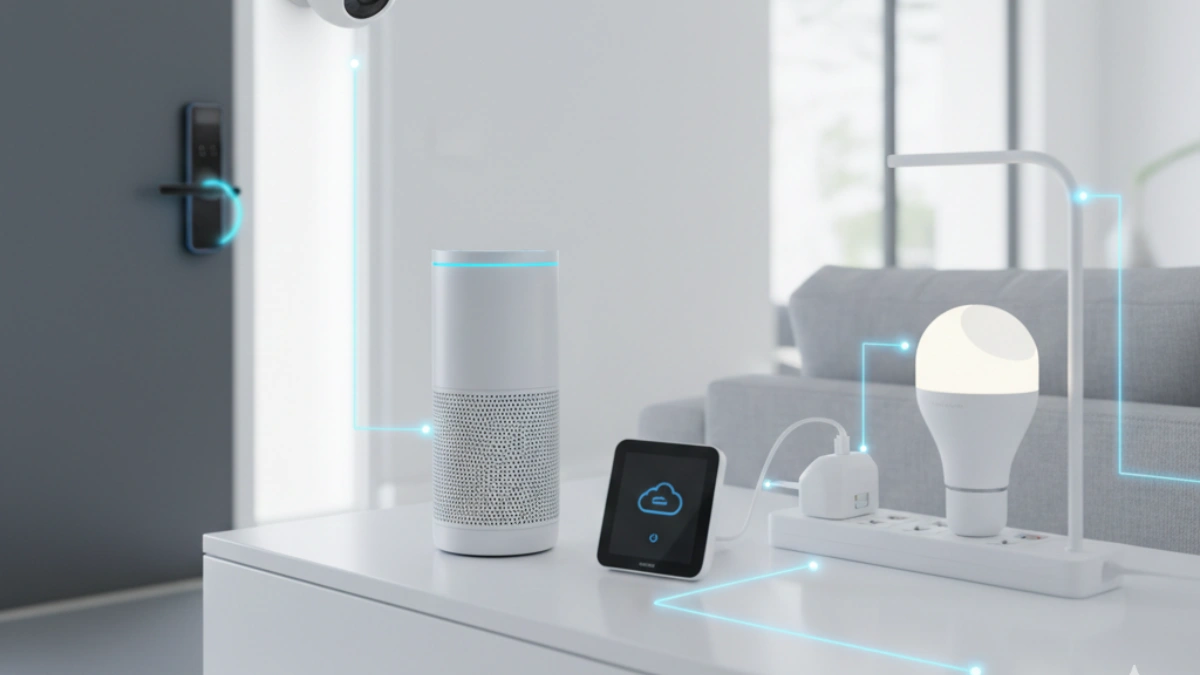 As we continue exploring Internet of Things Explained, let’s take a closer look at six key smart home devices that are redefining modern households.
Smart Thermostats
Smart thermostats are able to adjust the temperature in rooms automatically and learn your routine. They assist in energy-saving and cutting down electricity costs.
Smart Security Cameras
These are the cameras that enable the owners of homes to check on their property using smart phones. Motion detectors enhance security.
Smart Lighting Systems
Through an app or voice assistant, one can control lights. Lighting can be easily programmed or its brightness can be changed.
The voice Assistants and Smart Speakers
There is also the playback of music, setting up of reminders, and controlling of other devices that are connected to voice assistants via voice commands.
Smart Refrigerators
Contemporary refrigerators are able to track the stock level of food and even recommend shopping lists.
Smart Door Locks
These locks are remote access controlled and keyless entry which enhances the security of the home.
These devices clearly demonstrate how Internet of Things Explained applies to daily life.
Practical Applications of Internet of Things outside of Homes
Although Smart Home Devices are popular, IoT is also used in many other areas.
Healthcare
Wearable monitors monitor cardiopulmonary rate, sleep cycles, and physical exercise.
Agriculture
The IoT sensors are used by farmers to measure soil conditions and weather patterns.
Transportation
Smart cars enhance the navigation and safety.
Retail
Connected systems automatically track inventory at the stores.
Smart Cities
Energy management systems, waste control and traffic management systems are all dependent on IoT networks.
This shows that Internet of Things Explained is not limited to homes it impacts entire industries.
Benefits of Internet of Things Explained
The knowledge of the benefits would explain why the IoT is expanding at a high rate.
Convenience
Machines are saving time and effort which is done manually.
Energy Efficiency
Energy saved is used through smart light systems and thermostats.
Improved Security
Cameras and locks are smart, thus increasing safety.
Cost Savings
Green systems reduce energy expenses.
Remote Control
Smartphones allow users to operate devices remotely.
Better Decision-Making
Information obtained by sensors assists consumers in making wise decisions.
These benefits explain why Smart Home Devices are becoming common worldwide.
Internet of Things Securities and Awareness
IoT has numerous benefits, but it is significant to be aware of it and use it responsibly.
Data Privacy
Always passwords are to be used and they ought to be strong passwords as well as having two factor authentication.
Software Updates
Voice improved security by updating devices.
Trusted Brands
Purchase equipment of the well-known manufacturers.
Secure Wi-Fi Networks
Use safe and confidential internet links.
Familiarize oneself with Privacy Policies
Consider terms and conditions and use devices.
The need to keep abreast of events will keep the Internet of things technology safe and useful amongst ordinary users.
Key Challenges of Smart Home Devices
Although the IoT technology is useful, it has certain challenges:
-
Addiction to internet connectivity.
-
Initial setup costs
-
Privacy concerns
-
Brand something compatibility problems.
The knowledge of these issues aids users to make accountable choices.
Future Trends in Internet of Things Explained
The future of the IoT is bright. Some key trends include:
Artificial Intelligence Implementation
The smart devices will be smarter and predictive.
5G Connectivity
There will be communication between devices of faster networks.
Increased Automation
Houses will be made more autonomous.
Green Technology
IoT will be energy-efficiency solutions that will minimize environmental impact.
Better Security Systems
The user data will be secured by using advanced encryption.
As technology continues to advance, smart home devices are expected to become more efficient and increasingly common in households.
The Reasons Why Makerspaces and First-year Students need to Learn the fundamentals of the Internet of Things
The knowledge of IoT makes individuals:
-
Know how to use the modern technology.
-
Improve digital literacy
-
Be smarter in making buying choices.
-
Be aware of privacy of data.
Non technical people can also gain knowledge of how interconnected systems operate.
Common Confusion About Smart Home Devices
Myth 1: IoT Works Like Magic
Fact: There are numerous devices that are user friendly.
The first myth is that smart devices are not safe to use
Fact: When they have the right security settings, then most of them are usually safe.
Myth 3: IoT is too expensive
Reality: The fact of the matter is that, when they are configured correctly and have simple security measures, such as complex passwords and doing regular updates, they tend to be pretty secure regarding basic user needs.
Conclusion
In this comprehensive guide to the Internet of Things (IoT), we defined what international IoT is in non technical and easy to comprehend language. We also discussed how it works and how smart home devices are transforming modern homes by making them more convenient and efficient. Smart thermostats, security cameras, and other connected devices are other devices that are turning houses more convenient, efficient, and safer.
Although there are privacy and security factors involved, risks can be mitigated by using in a responsible manner and being aware. Due to the constant advancement of technology, IoT will further contribute to the development of smart living conditions and online lifestyle.
This knowledge of these concepts will make beginners confident and responsible in using smart technology.
FAQs
In a simple language, what is the Internet of Things?
It refers to a chain of physical machines linked to the internet which are able to gather and distribute information.
What are Smart Home Devices?
Smart thermostats, smart lights, and cameras among other devices are internet-connected devices that can be operated remotely.
Is IoT safe to use at home?
Yes, as long as the users observe security measures like strong passwords and updates.
Do smart home devices help save electricity?
Yes, the number of devices that are aimed at enhancing energy efficiency is high.
Is it possible to operate IoT in the absence of the internet?
A majority of the IoT devices are unable to work without being connected to the internet.
Are smart home devices expensive?
Prices are different, and there is a broad choice of affordable ones.
What are other areas of IoT in other industries?
IoT systems are used in healthcare, agriculture, transportation, and retail industry.
What is the future of IoT?
The future involves the implementation of AI, the connection speed, and enhanced security systems.